
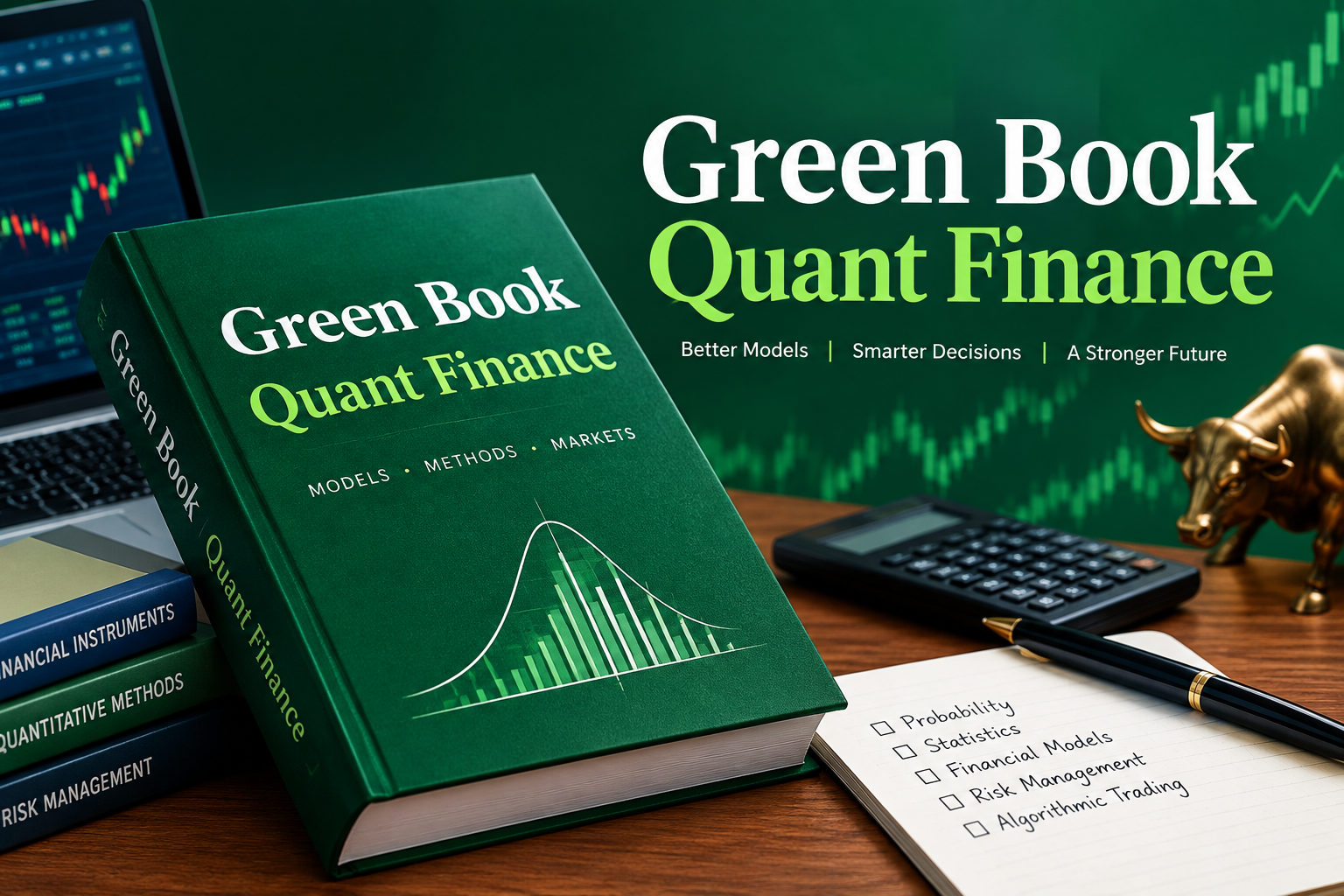
If you are preparing for a career in quantitative finance, you have probably heard the term “Green Book.” In the quant community, this name commonly refers to A Practical Guide to Quantitative Finance Interviews by Xinfeng Zhou, a popular problem-solving resource for candidates preparing for quantitative finance interviews.
The book is known as the Green Book because of its distinctive green cover. More importantly, it has become associated with the mathematical reasoning, probability, financial knowledge, and analytical problem-solving skills that are frequently tested in quantitative finance interviews.
Quantitative finance combines mathematics, statistics, probability, programming, economics, and financial theory. Depending on the role, candidates may be asked to solve probability puzzles, derive mathematical relationships, analyze financial instruments, write algorithms, or reason through unfamiliar problems under time pressure.
The Green Book is valuable because it focuses heavily on this type of problem-solving.
However, it is important to understand what the Green Book can and cannot provide. It is primarily an interview preparation resource, not a complete textbook covering every area of quantitative finance. To build a strong career in quant finance, candidates should combine Green Book preparation with deeper study of probability, statistics, stochastic processes, derivatives, programming, algorithms, and financial markets.
What Is the Green Book in Quant Finance?
The Green Book refers to A Practical Guide to Quantitative Finance Interviews by Xinfeng Zhou.
Unlike a traditional university textbook, the book is strongly focused on problems and solutions. Instead of spending most of its pages developing theory before presenting exercises, it places the reader directly into mathematical, logical, and financial problems.
Major areas include:
- Probability
- Combinatorics
- Mathematical puzzles
- Calculus
- Linear algebra
- Stochastic processes
- Stochastic calculus
- Finance
- Derivatives
- Algorithms
- Numerical methods
This makes the book particularly useful for students who already have some mathematical knowledge and want to understand how that knowledge can be applied during quantitative interviews.
The central idea is simple:
Quantitative interviews are not only about knowing formulas. They are about demonstrating how you think.
A candidate might know the Black-Scholes formula, for example, but that alone does not demonstrate quantitative ability. An interviewer may instead ask the candidate to derive part of a model, explain an assumption, calculate an expectation, or solve an unfamiliar probability problem.
The candidate therefore needs both technical knowledge and structured reasoning.
Why Is the Green Book Important for Quant Interviews?
Quantitative finance is highly mathematical.
Depending on the role, a quantitative professional may work with:
- Probability
- Statistics
- Optimization
- Stochastic processes
- Numerical methods
- Machine learning
- Algorithms
- Financial derivatives
- Time-series models
- Market data
Because of this, quantitative interviews frequently test mathematical reasoning.
Consider a simple probability problem:
A fair coin is tossed repeatedly. What is the expected number of tosses before two consecutive heads appear?
At first glance, the problem looks simple. However, an effective solution requires recognizing different states.
Let:
- E0E_0 represent the expected number of additional tosses when there is no previous head.
- E1E_1 represent the expected number of additional tosses when the previous toss was a head.
Then:
E0=1+12E0+12E1E_0=1+\frac{1}{2}E_0+\frac{1}{2}E_1
And:
E1=1+12E0E_1=1+\frac{1}{2}E_0
Solving these equations gives:
E0=6E_0=6
Therefore, the expected number of tosses is 6.
The important lesson is not memorizing the number six.
The important lesson is learning how to recognize the underlying structure of the problem.
That is one of the main skills developed through Green Book-style questions.
Probability: The Foundation of Quantitative Finance
Probability is one of the most important subjects for anyone preparing for a quant career.
A strong candidate should understand:
- Conditional probability
- Independence
- Bayes’ theorem
- Random variables
- Probability distributions
- Expected value
- Variance
- Covariance
- Conditional expectation
- Combinatorics
- Law of total probability
- Law of total expectation
For example, Bayes’ theorem is:
P(A∣B)=P(B∣A)P(A)P(B)P(A|B)=\frac{P(B|A)P(A)}{P(B)}
Although this is a basic probability equation, conditional reasoning appears throughout quantitative finance.
It can be used when thinking about uncertain information, statistical models, risk, forecasting, and inference.
Expected Value
Expected value is particularly important.
For a discrete random variable:
E[X]=∑xxP(X=x)E[X]=\sum_x xP(X=x)
For a continuous random variable:
E[X]=∫−∞∞xfX(x) dxE[X]=\int_{-\infty}^{\infty}xf_X(x)\,dx
Candidates should become comfortable manipulating expectations rather than treating them as formulas that need to be memorized.
For example:
E[aX+b]=aE[X]+bE[aX+b]=aE[X]+b
and:
Var(aX+b)=a2Var(X)Var(aX+b)=a^2Var(X)
Understanding these relationships allows candidates to solve many interview questions quickly.
Calculus and Linear Algebra
Calculus is another essential component of quantitative finance.
Important topics include:
- Differentiation
- Integration
- Partial derivatives
- Optimization
- Differential equations
- Multivariable calculus
- Taylor expansions
These concepts appear in financial modeling, derivatives pricing, optimization, and risk analysis.
For example, the Black-Scholes framework leads to the following partial differential equation:
∂V∂t+12σ2S2∂2V∂S2+rS∂V∂S−rV=0\frac{\partial V}{\partial t} + \frac{1}{2}\sigma^2S^2 \frac{\partial^2V}{\partial S^2} + rS\frac{\partial V}{\partial S} -rV=0
Understanding this equation requires knowledge of calculus as well as financial interpretation.
A candidate should not simply memorize the equation. They should understand what the variables represent and why the equation has this structure.
Linear Algebra
Linear algebra is equally important.
Candidates should be familiar with:
- Vectors
- Matrices
- Matrix multiplication
- Eigenvalues
- Eigenvectors
- Rank
- Linear transformations
- Covariance matrices
- Positive-definite matrices
Linear algebra is used in areas such as:
- Portfolio optimization
- Risk modeling
- Factor models
- Statistics
- Machine learning
- Numerical methods
Strong linear-algebra skills can therefore be useful far beyond the interview itself.
Stochastic Processes and Stochastic Calculus
Stochastic processes form another major part of mathematical finance.
Financial markets contain uncertainty, so mathematical models often represent prices and other variables as stochastic processes.
One of the most important processes is Brownian motion, commonly represented by WtW_t.
For t>st>s:
Wt−Ws∼N(0,t−s)W_t-W_s\sim N(0,t-s)
This means that the change in Brownian motion over a time interval is normally distributed with mean zero and variance equal to the length of the interval.
This idea leads to stochastic differential equations.
A common model for an asset price is:
dSt=μStdt+σStdWtdS_t=\mu S_tdt+\sigma S_tdW_t
where:
- StS_t is the asset price
- μ\mu represents the drift
- σ\sigma represents volatility
- dtdt represents the passage of time
- dWtdW_t represents the random component
Understanding stochastic processes is important for derivatives pricing, risk management, and financial modeling.
However, candidates should recognize that the Green Book provides interview-oriented preparation rather than a complete treatment of stochastic calculus. Students interested in mathematical finance should study stochastic calculus more deeply through dedicated textbooks and courses.
Finance and Derivatives
Quantitative finance is not only mathematics.
A candidate also needs to understand financial instruments and market concepts.
Important areas include:
- Stocks
- Bonds
- Options
- Futures
- Forward contracts
- Swaps
- Arbitrage
- Hedging
- Interest rates
- Volatility
- Greeks
- Option pricing
One of the fundamental relationships in options pricing is put-call parity:
C−P=S0−Ke−rTC-P=S_0-Ke^{-rT}
where:
- CC is the call price
- PP is the put price
- S0S_0 is the current underlying price
- KK is the strike price
- rr is the risk-free interest rate
- TT is the time to maturity
A strong candidate should understand why this relationship exists rather than simply memorizing it.
The underlying idea is no-arbitrage.
If two portfolios produce identical future cash flows, their prices should be consistent under the relevant assumptions. If they are not, a trader may potentially construct an arbitrage strategy.
This concept is fundamental to modern mathematical finance.
Brain Teasers and Quantitative Reasoning
One of the distinctive features of quantitative interviews is the use of mathematical puzzles and brain teasers.
These questions may involve:
- Coins
- Dice
- Cards
- Games
- Sequences
- Combinatorics
- Optimization
- Logic
- Expected values
The interviewer is often less interested in whether you immediately know the answer and more interested in how you approach the problem.
Consider the famous 100-door problem.
There are 100 doors, initially closed. On the first pass, every door is changed. On the second pass, every second door is changed. On the third pass, every third door is changed. This continues until the 100th pass.
Which doors remain open?
A door is changed once for every divisor of its number.
Most numbers have divisors that occur in pairs.
For example:
12=1×12=2×6=3×412=1\times12=2\times6=3\times4
Therefore, 12 has an even number of divisors.
Perfect squares are different because one factor is paired with itself.
For example:
16=1×16=2×8=4×416=1\times16=2\times8=4\times4
Therefore, 16 has an odd number of divisors.
As a result, the doors that remain open correspond to perfect squares:
1,4,9,16,25,36,49,64,81,1001,4,9,16,25,36,49,64,81,100
The lesson is more important than the answer.
Instead of checking every door individually, identify the mathematical structure.
That ability is extremely valuable in quantitative work.
Programming and Algorithms
Modern quantitative finance is closely connected with programming.
Depending on the role, a quant may need to:
- Process financial datasets
- Build statistical models
- Backtest trading strategies
- Implement pricing models
- Perform numerical simulations
- Develop optimization algorithms
- Analyze large datasets
- Build research infrastructure
Important programming languages include Python and C++.
Python
Python is widely used for:
- Data analysis
- Statistics
- Machine learning
- Quantitative research
- Backtesting
- Visualization
Important Python libraries include:
- NumPy
- pandas
- SciPy
- scikit-learn
- Matplotlib
C++
C++ can be particularly important for performance-sensitive applications.
Candidates should understand:
- Data structures
- Algorithms
- Complexity
- Memory management
- Object-oriented programming
- Numerical computation
- Performance optimization
Programming ability can be particularly important for quantitative developer and quantitative researcher positions.
Is the Green Book Enough to Become a Quant?
No.
The Green Book is useful, but it should not be considered a complete quantitative-finance education.
Different quant careers require different skill sets.
Quantitative Research
A quantitative researcher may need strong knowledge of:
- Probability
- Statistics
- Machine learning
- Time-series analysis
- Econometrics
- Optimization
- Programming
- Experimental design
Derivatives Quant
A derivatives-focused quant may need deeper knowledge of:
- Stochastic calculus
- Partial differential equations
- Numerical methods
- Monte Carlo simulation
- Volatility modeling
- Fixed income
- Option pricing
Quantitative Trader
A quantitative trader may need:
- Probability
- Statistics
- Mental mathematics
- Market microstructure
- Game theory
- Programming
- Decision-making under uncertainty
Quantitative Developer
A quantitative developer may need:
- C++
- Python
- Algorithms
- Data structures
- Systems programming
- Numerical methods
- Software engineering
Therefore, the Green Book should be viewed as one component of a larger preparation strategy.
How to Study the Green Book Effectively
Simply reading the solutions is not the most effective way to use the book.
A better approach is to treat every question as a problem-solving exercise.
Step 1: Attempt the Problem
Give yourself approximately 10–20 minutes.
Try to solve the problem independently.
Do not immediately look at the answer.
Step 2: Identify the Structure
Ask yourself:
- What information is given?
- What needs to be calculated?
- What assumptions are present?
- Is this a probability problem?
- Is there a symmetry?
- Can the problem be broken into states?
- Is there a simpler representation?
Step 3: Explain Your Reasoning
Write down your solution.
Even if the solution is incomplete, recording your thought process makes it easier to identify mistakes.
Step 4: Study the Solution
After making a serious attempt, compare your method with the book.
Ask:
Why does the book use this approach?
Can I solve the problem differently?
What general principle can I learn from this question?
Step 5: Revisit Difficult Problems
Return to difficult questions several days later.
If you can solve a problem without looking at the solution after several days, you are developing genuine understanding rather than short-term memory.
A 12-Week Green Book Study Plan
Weeks 1–2: Probability
Study:
- Conditional probability
- Bayes’ theorem
- Expected value
- Variance
- Distributions
- Combinatorics
Focus on developing intuition.
Weeks 3–4: Brain Teasers
Practice:
- Logic puzzles
- Probability puzzles
- Counting problems
- Games
- Estimation
- Recursion
Try to solve problems without calculators.
Weeks 5–6: Calculus and Linear Algebra
Review:
- Derivatives
- Integrals
- Optimization
- Matrices
- Eigenvalues
- Eigenvectors
- Covariance matrices
Weeks 7–8: Stochastic Processes
Study:
- Random walks
- Markov chains
- Brownian motion
- Martingales
- Conditional expectation
- Stochastic differential equations
Weeks 9–10: Finance
Review:
- Options
- Futures
- Forwards
- Arbitrage
- Put-call parity
- Black-Scholes
- Greeks
- Hedging
Weeks 11–12: Algorithms and Mock Interviews
Start combining different subjects.
Set a timer.
Choose random problems.
Solve them aloud.
Then explain the solution as if an interviewer were sitting in front of you.
This final stage is important because knowing how to solve a problem privately is different from communicating a solution clearly under pressure.
Common Mistakes When Studying the Green Book
1. Memorizing Solutions
Memorizing answers is dangerous.
An interviewer can modify a small condition and completely change the problem.
Instead, learn the underlying method.
2. Ignoring Probability
Probability is one of the most important mathematical foundations for quantitative finance.
Do not treat it as just another chapter.
3. Focusing Only on Finance
Knowing financial terminology does not compensate for weak mathematics.
A strong quant candidate needs both financial understanding and quantitative reasoning.
4. Ignoring Programming
Modern quantitative finance depends heavily on computation, data, and algorithms.
Programming should therefore be part of your preparation.
5. Looking at Solutions Too Quickly
Difficulty is part of the learning process.
If you immediately read the answer, you lose an opportunity to train your own problem-solving ability.
6. Not Practicing Under Time Pressure
Quantitative interviews are usually time-constrained.
You should practice solving problems quickly while maintaining accuracy.
Who Should Study the Green Book?

The Green Book can be particularly useful for people preparing for:
- Quantitative researcher positions
- Quantitative analyst positions
- Quantitative trader positions
- Derivatives quant positions
- Quantitative developer positions
- Financial engineering programs
- Quantitative finance internships
It is especially useful for students who already have a mathematical foundation and want to become comfortable with interview-style problems.
If you are completely new to mathematics, however, it may be better to first build a foundation in probability, calculus, linear algebra, and statistics.
Green Book and Modern Quant Finance
The financial industry has changed significantly over the years.
Traditional mathematical finance remains important, but modern quantitative research increasingly involves:
- Machine learning
- Alternative data
- Large datasets
- Statistical modeling
- High-performance computing
- Automated trading
- Advanced optimization
- Natural language processing
This does not make classical mathematics irrelevant.
In fact, mathematical fundamentals become even more valuable because they help you understand what modern models are actually doing.
A candidate who knows machine learning but does not understand probability may struggle to evaluate whether a statistical result is meaningful.
Similarly, someone who knows financial terminology but cannot reason about distributions, expectations, or optimization may struggle with technical quantitative work.
The strongest preparation combines classical quantitative foundations with modern computational skills.
Final Thoughts
The Green Book is best understood as a training ground for quantitative problem-solving.
Its greatest value is not the individual answers.
Its real value is the thinking process behind those answers.
A strong quant candidate does not simply memorize:
E[X+Y]=E[X]+E[Y]E[X+Y]=E[X]+E[Y]
They ask:
Why does this work?
What assumptions are required?
What happens if the variables are dependent?
Can I derive the result another way?
How could this idea apply to a financial problem?
That style of thinking is much more valuable than memorizing hundreds of interview questions.
If you are preparing for a quantitative-finance career, use the Green Book as a structured problem-solving resource. At the same time, develop deeper knowledge of probability, statistics, stochastic calculus, derivatives, programming, algorithms, and modern quantitative research.
Ultimately, the goal should not simply be to say:
“I finished the Green Book.”
The goal is to reach the point where an unfamiliar quantitative problem does not intimidate you.
You can break it into smaller pieces.
You can identify the relevant mathematical concepts.
You can make and test assumptions.
You can calculate carefully.
And most importantly, you can explain why your answer makes sense.
That is the real skill behind successful quantitative-finance interview preparation.
| Read Also: 6 Effective Dermatology Treatments for Skin |